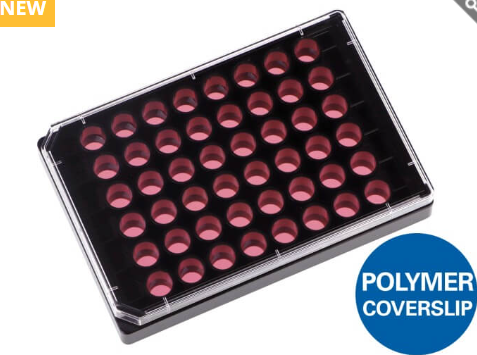
เพลตเพาะเลี้ยงเซลล์แบบ 48 หลุมสีดำ ก้นใสและเรียบ สำหรับการเพาะเลี้ยงเซลล์และงานกล้องจุลทรรศน์
- เพลตแบบหลายหลุม (Multiwell Plate) ที่มาพร้อม #1.5 Polymer Coverslip Bottom รองรับการถ่ายภาพเซลล์คุณภาพสูงและงานกล้องจุลทรรศน์ขั้นสูง
- มีความเรียบสูงทั้งภายในแต่ละหลุมและทั่วทั้งแผ่นเพลต ช่วยเพิ่มความแม่นยำสำหรับการวิเคราะห์และคัดกรองตัวอย่างแบบอัตโนมัติ (Automated Screening)
- ผนังหลุมสีดำช่วยลดการรบกวนของสัญญาณฟลูออเรสเซนซ์ระหว่างหลุม (Well-to-Well Crosstalk) ทำให้ได้ผลลัพธ์ที่ชัดเจนและเชื่อถือได้มากขึ้น
การทำ Cell-Based Assays แบบขนานด้วย µ‑Plate 48 Well
เปรียบเทียบการทดลองหลายเงื่อนไขพร้อมกันได้อย่างมีประสิทธิภาพ ไม่ว่าจะเป็นการทดสอบสารหลายชนิด ความเข้มข้นที่แตกต่างกัน ชนิดของเซลล์ หรือสภาวะการเพาะเลี้ยงที่หลากหลาย โดยยังคงมีจำนวนเซลล์เพียงพอสำหรับการถ่ายภาพด้วยกล้องจุลทรรศน์และการวิเคราะห์ผลในขั้นตอนสุดท้าย
รูปแบบ 48 หลุม เป็นจุดสมดุลที่เหมาะสมระหว่าง
- ประสิทธิภาพในการทำงานแบบ High-Throughput
- ความสะดวกในการจัดการตัวอย่างด้วยมือ
- ปริมาณตัวอย่างที่เพียงพอสำหรับการวิเคราะห์เพิ่มเติม
จึงเหมาะอย่างยิ่งสำหรับ
- การพัฒนาและปรับแต่งการทดสอบ (Assay Optimization)
- การศึกษาความสัมพันธ์ระหว่างขนาดยาและการตอบสนอง (Dose-Response Studies)
- การเปรียบเทียบผลการทดลองทางเซลล์ภายใต้หลายเงื่อนไข (Comparative Cell-Based Experiments)
จุดเด่น
- เหมาะสำหรับงาน Cell Culture, Immunofluorescence (IF) และ Fluorescence Microscopy
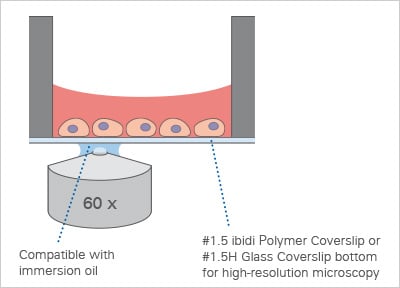
- รองรับการถ่ายภาพความละเอียดสูงผ่านก้นหลุมแบบ Coverslip
- ผนังสีดำช่วยลดสัญญาณรบกวนระหว่างหลุม
- ความเรียบสูง รองรับระบบ Automated Screening และ High-Content Imaging
- ช่วยเพิ่มจำนวนการทดลองที่ทำได้พร้อมกัน โดยยังคงคุณภาพของข้อมูลและภาพถ่ายระดับงานวิจัยขั้นสูง
Black 48 well culture plate with a flat and clear bottom for cell culture and microscopy
- Multiwell plate for high-end imaging through a #1.5 Polymer Coverslip
- Excellent inner well flatness and whole plate flatness for automated screening
- Black walls for low well-to-well crosstalk during fluorescence microscopy
Parallel Cell-Based Assays With the µ-Plate 48 Well
Compare multiple treatments, concentrations, cell types, or culture conditions in parallel while maintaining sufficient cell numbers for microscopy and downstream endpoint analysis. The 48 well format provides an efficient balance between throughput, convenient manual handling, and sample availability, making it ideal for assay optimization, dose response studies, and comparative cell-based experiments.
High-Resolution Immunofluorescence Imaging
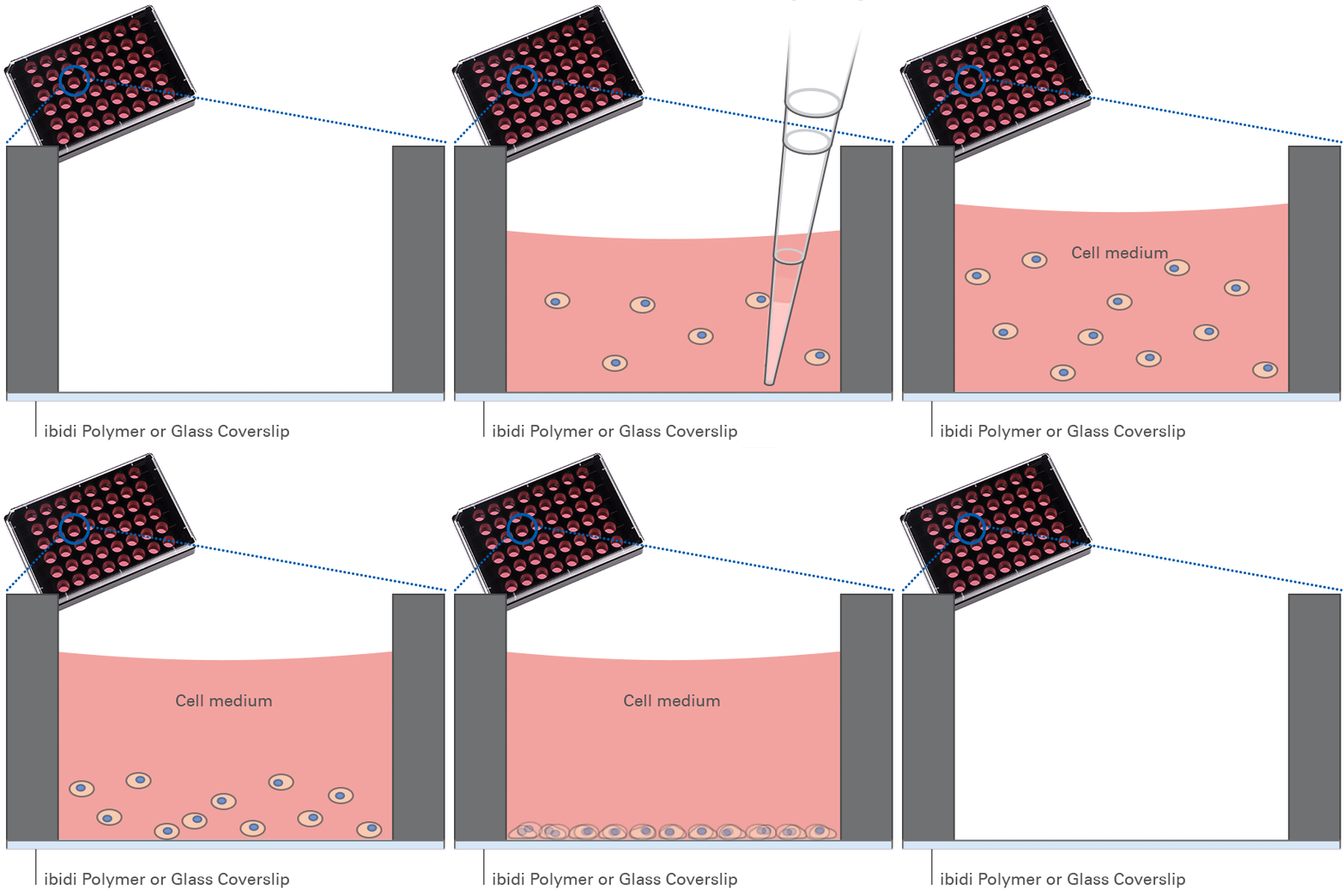
The ibidi µ-Plate 48 Well allows standard immunofluorescence protocols to be performed directly in the plate format. Cell cultivation, fixation, staining, and imaging can all be performed in the open wells. After staining, samples are imaged directly through the coverslip bottom using high-resolution microscopy.
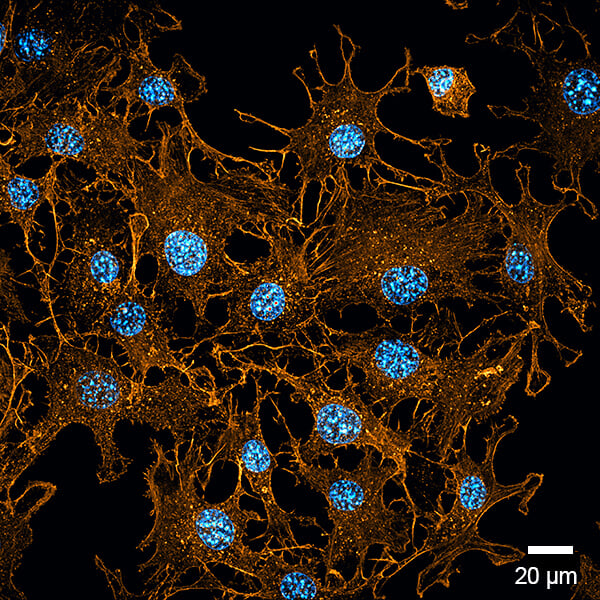
NIH-3T3 cells in the µ-Plate 48 Well ibiTreat, acquired using a Zeiss Elyra 7 microscope. Images were recorded using sequential Nyquist-sampling in SIM Apotome mode, followed by SIM2 Processing and displayed as a maximum intensity projection. Cell nuclei were stained with DAPI (blue), actin with phalloidin (orange). 20x objective lens. Scale bar 20 µm.
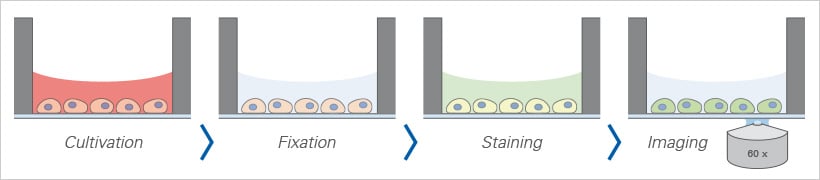
Example immunofluorescence workflow in the µ-Plate 48 Well: cell cultivation, fixation, staining, and imaging can be performed directly in the same plate.
Live Cell Imaging and Cell-Based Assays
Use the µ-Plate 48 Well for parallel cell culture experiments with low cell numbers and reagent volumes. Applications include live cell imaging and time-lapse studies, gene and protein expression analysis, transfection assays, drug discovery studies, cytotoxicity assays, and toxicology screenings. For stable temperature, O2/CO2, and humidity during long-term imaging, the plate can be used together with an ibidi Stage Top Incubator.
Advanced Microscopy and Quantitative Readouts
The µ-Plate 48 Well supports brightfield, phase contrast, and widefield fluorescence microscopy on inverted microscopes. It can also be used for confocal microscopy, two-photon microscopy, FRAP, FRET, FLIM, and LSFM, as well as automated multiparametric high-content screening and high-throughput screening with plate readers.
Specifications
| Outer dimensions (l × w) | 127.8 × 85.5 mm |
| Number of wells | 48 |
| Height with/without lid | 22.4 / 20.0 mm |
| Well-to-well distance | 12.6 mm |
| Single well diameter | 9.6 mm |
| Single well depth | 18.5 mm |
| Volume per well | 750 µl |
| Growth area per well | 0.8 cm² |
| Coating area per well using 750 µl | 3.8 cm² |
| Bottom material | #1.5 ibidi Polymer Coverslip (different surfaces available) |
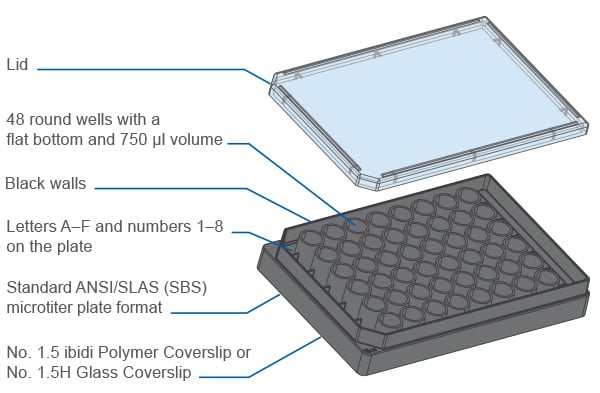
For technical drawings and details, please see:
Instructions µ-Plate 48 Well (PDF)
Technical Features
Precision, Quality, and Biocompatibility
- µ-Plate (microtiter plate) in ANSI/SLAS (SBS) format
- Ready-to-use for lab automation and high-throughput workflows with robotics, fluorescence scanners, and plate readers
- 48 round wells with standard numbering (letters A–F and numbers 1–8)
- Excellent inner well flatness and whole plate flatness
- #1.5 ibidi Polymer Coverslip with excellent optical quality
- No autofluorescence due to black walls
- Compatible with staining and fixation solutions
- Compatible with immersion oil
- Made from non-cytotoxic, biocompatible materials
- Sterile and individually packaged
Product Versions
- With #1.5 ibidi Polymer Coverslip (different surfaces available)
Clear, White, or Black Wells?
Need a special material
for your assay?
How Does the µ-Plate 48 Well Work?
The µ-Plate 48 Well provides 48 independent wells on a thin, high-performance #1.5 ibidi Polymer Coverslip. The flat, transparent imaging bottom delivers excellent optical quality and, together with the chosen surface, supports defined, reproducible cell adhesion. The ibiTreat tissue culture-treated surface has been designed for optimal cell adhesion on the #1.5 ibidi Polymer Coverslip bottom. This modification provides ideal growth conditions for nearly all types of adherent cells, eliminating the need for additional coatings.
µ-Plate 48 Well at a Glance
| Product type | 48 well cell culture and imaging microplate |
| Best suited for | Parallel cell culture, immunofluorescence, live cell imaging, and cell-based assays |
| Well geometry | 48 round wells with a diameter of 9.6 mm and a flat, transparent imaging bottom |
| Bottom | #1.5 ibidi Polymer Coverslip with different surface options |
| Volume and growth area per well | 750 µl; 0.8 cm² |
| Format | ANSI/SLAS (SBS) microplate format |
The ibidi µ-Plate Range
 |  | 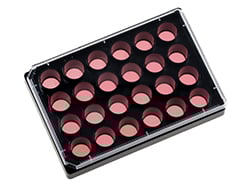 | 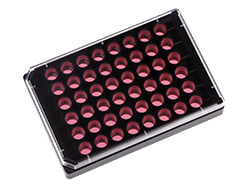 | 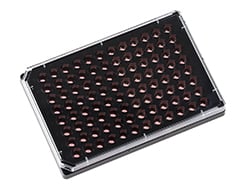 | 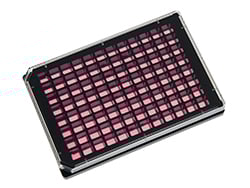 |  |  | |
| 6 Well | 12 Well | 24 Well | 48 Well | 96 Well Round | 96 Well Square | 384 Well | 384 Well Clear | |
| Bottom |   | | | | | | | |
| Volume / well | 5 ml | 3 ml | 1 ml | 750 µl | 200 µl | 300 µl | 50 µl | 50 µl |
| Growth area / well | 9.1 cm² | 3.6 cm² | 1.54 cm² | 0.8 cm² | 0.3 cm² | 0.56 cm² | 0.11 cm² | 0.11 cm² |
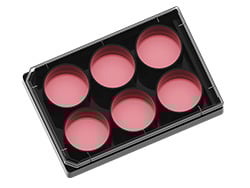
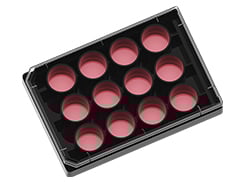
The ibidi µ-Plates are specifically designed for cell culture, immunofluorescence, and high-end microscopy. They offer flexibility in well size, well volume, and bottom materials. The range includes formats from 6 to 384 wells. All ibidi multiwell plates are user-friendly and ideal for multiplexing and high-throughput applications, providing high optical quality and compatibility with robotic systems. Most µ-Plates are available with either a #1.5 ibidi Polymer Coverslip or #1.5H Glass Coverslip bottom.
For a detailed comparison of coverslip materials, optical properties, and compatibility, visit the ibidi Material Comparison.
Frequently Asked Questions About the µ-Plate 48 Well
What Is the µ-Plate 48 Well Used for?
The µ-Plate 48 Well is designed for parallel cell culture and imaging workflows, including immunofluorescence staining, brightfield and fluorescence microscopy, and live cell imaging on inverted microscopes. Typical applications include condition screening, dose response experiments, and the comparison of multiple controls and replicates within a single plate.
Is the µ-Plate 48 Well Compatible With Automated Handling?
Yes. The µ-Plate 48 Well has a standard ANSI/SLAS microplate footprint, making it compatible with common stage inserts, plate holders, and automated laboratory equipment. It is well suited for automated liquid handling and supports reproducible medium-throughput and high-throughput assays using robotic systems, fluorescence scanners, and plate readers.
Is the µ-Plate 48 Well Suitable for Live Cell Imaging?
Yes. The coverslip bottom provides the optical performance required for long-term live cell imaging. For stable temperature, O2/CO2, and humidity, it can be used with the ibidi Stage Top Incubator.
How Do I Conduct Immunofluorescence Stainings With the µ-Plate 48 Well?
The µ-Plate 48 Well is well suited for immunofluorescence (IF) assays. 48 separate wells allow researchers to analyze multiple conditions, controls, and replicates in parallel. Washing, fixation, permeabilization, blocking, and staining can be performed directly in the wells. The imaging bottom provides excellent optical performance for widefield fluorescence, confocal, and other high-resolution microscopy techniques. No additional coverslip mounting or sample transfer is required.
Packaging Information
| Cat. No. | Packaging Unit | Packaging Dimensions (l × w × h) | Shipping Weight |
|---|---|---|---|
| 84801, 84806, 84807 | 15 (indiv. packed) | 301 × 173 × 151 mm | 1.3 kg |
| 84801-90, 84806-90, 84807-90 | 90 (indiv. packed) | 505 × 319 × 244 mm | 7.8 kg |